The ILWU Story
The ILWU Story
The Warehouse Industry
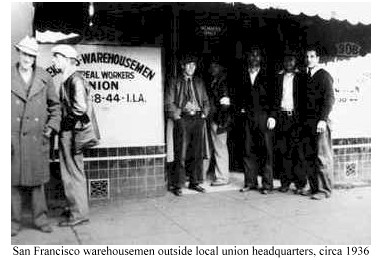
The new kind of unionism born of the 1934 maritime strike was not confined to the docks. The warehouse workers, with their close ties to the waterfront that in the early days of the union came from working near the docks and handling cargo brought on and off the ships by longshoremen, also helped build the ILWU and they too shared in its achievements.
 Today the Warehouse Division of the ILWU is a dynamic section of the union,
tested and fortified by rank-and-file sacrifices and victories.
Today the Warehouse Division of the ILWU is a dynamic section of the union,
tested and fortified by rank-and-file sacrifices and victories.
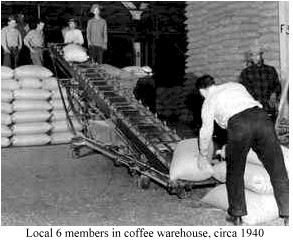
Its members, men and women of all races and beliefs, are employed in public warehouses, coffee and spice warehouses, liquor and bottling plants, laboratories, open pit mines, hospitals, sugar refineries and chemical plants, flour and feed mills, food processing establishments and grocery and hardware warehouses. Some work in large establishments, others in companies with but a handful of employees. Warehousing involves the storage, processing and distribution of goods, as well as some manufacturing.
Though warehouse workers suffered low wages, high job insecurity and frequent speed-ups, the old AFL craft unions never considered organizing the men and women who earned a precarious living in the distribution centers up and down the West Coast. But under the impetus of the successful 1934 maritime strike, the warehousemen organized.
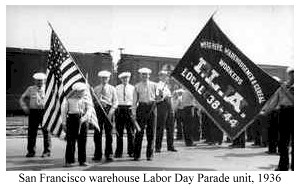
In August 1934 new members of Weigher's, Warehousemen's and Cereal Workers Union Local 38-44 (later to become ILWU Local 6 in the San Francisco Bay Area) reactivated the local's ILA charter, which had been inactive since 1923, and immediately started a vigorous organizing campaign.
 In
this they had the full support of the longshoremen. The leaders of the newly
reorganized longshore union realized that unless the warehousemen-who often
worked near the docks-also enjoyed union conditions, and worked under a
union contract, they could undermine longshore standards and be a source of
cheap labor, even strikebreakers. By
the spring of 1935 the new union, was firmly established on the waterfront
and already moving uptown and 'marching inland."
In
this they had the full support of the longshoremen. The leaders of the newly
reorganized longshore union realized that unless the warehousemen-who often
worked near the docks-also enjoyed union conditions, and worked under a
union contract, they could undermine longshore standards and be a source of
cheap labor, even strikebreakers. By
the spring of 1935 the new union, was firmly established on the waterfront
and already moving uptown and 'marching inland."
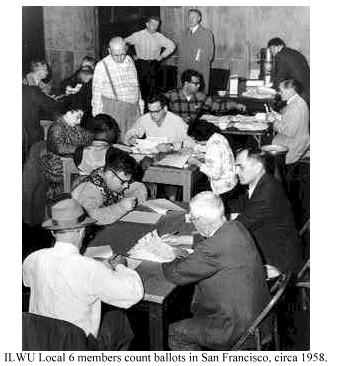
By the end of the year, dramatic signs of the union's growth were evident: warehouse workers at the huge C&H sugar refinery in Crockett, California broke the company's stranglehold on the town and the work force to sign up with ILA Local 38-44; and warehouse workers rapidly organized in the anti-labor valley around Sacramento, California, and established ILA Local 38-118 (later ILWU Local 17). By 1943 some 85 percent of the warehouse workers in Sacramento belonged to the new union.
 But
these organizing efforts were brutally opposed by the warehouse employers
and by AFL officials who insisted that the uptown warehouses, as well as
those on the waterfront, were their exclusive jurisdiction.
But
these organizing efforts were brutally opposed by the warehouse employers
and by AFL officials who insisted that the uptown warehouses, as well as
those on the waterfront, were their exclusive jurisdiction.
All through 1935 in the San Francisco Bay Area employers, police and AFL vigilantes waged pitched battles against the organizing and bargaining efforts of Local 38-44.
From Crockett to Stockton, where strike leader Ray Morency was killed, warehousemen politically and physically defended their organization and their affiliation with the longshoremen,
Organizing efforts elsewhere met equal resistance -- and equal success. The Seattle warehouse local that became ILWU Local 9 cut its teeth on an October 1935 strike against Fisher Mills that became a symbolic fight throughout the Northwest. The Chamber of Commerce brought financial support and strikebreakers to open the mill.
The newly formed union marshaled the entire labor movement of the area to its defense. After four months of hardship and suffering the warehousemen's strike and boycott produced an outstanding victory.
In fact, the boycott of Fisher Mills products was one of the most effective in labor history. Bakery workers struck as far away as Richmond, Virginia. In Gulf cities, loggers shut down their camps. Longshore gangs and ships' crews all over the world walked off ships rather than handle Fisher flour.
Portland,
Los Angeles and other port cities also saw successful organizing drives. The
"march inland' took on real organizational emphasis in early 1936, and
in June the warehousemen held their first coastwise conference to develop a
West Coast membership drive.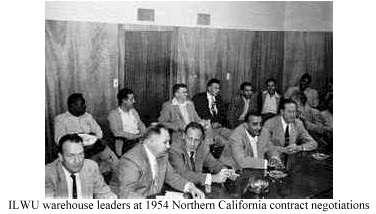
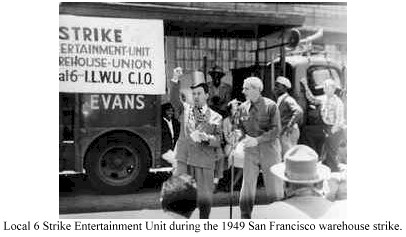
The San Francisco Bay Area warehousemen struck with the maritime unions in October 1936, and emerged with gains in organizing as well as bargaining. After 67 days out the warehousemen won one of the most unusual victories in American labor history.
To protect themselves during the strike the warehousemen aggressively organized workers in nearby nonunion warehouses and ended up almost doubling their membership in the process.
Moreover, through the strike action they won the union hiring hall, a substantial wage increase, paid vacations, and seniority rights in place of the continuous turnover that had always characterized the industry.
The warehousemen returned to work on January 5, 1937, but the maritime crafts were still out. In a demonstration of solidarity, the San Francisco Bay Area warehousemen contributed $1,000 each week to the joint strike fund until the maritime strike ended successfully on February 4th.
This victory in the San Francisco Bay Area inspired warehousemen up and down the coast. New organizations spread widely in every port city and later in many key communities in the interior of the United States and on the East and Gulf Coasts as well.
 At
the prompting of the head of the International Brotherhood of Teamsters (IBT)
Dave Beck and ILA leader Joe Ryan, the national AFL tried to strip the West
Coast longshore union of its warehouse affiliates in 1937.
At
the prompting of the head of the International Brotherhood of Teamsters (IBT)
Dave Beck and ILA leader Joe Ryan, the national AFL tried to strip the West
Coast longshore union of its warehouse affiliates in 1937.
Warehousemen and longshoremen alike fought back. The longshoremen recognized that the loss of the warehousemen would not only have ended effective union organization in that industry but weakened the waterfront unions as well.
Later that year the Pacific Coast district of the ILA joined the CIO, in part because members realized that the longshoremen and warehousemen had to remain in a single organization for their mutual advantage and benefit.<
So the successor organization became in name what it had long been in fact, a union of longshoremen and warehousemen: the ILWU, affiliated to the CIO.
But the warehouse workers' struggle was not over. In the months following CIO affiliation, they fought time and time again to preserve their union against raids by the Teamsters and other unions-and to maintain their close relationship with the longshoremen.
 Teamster chief Dave Beck pulled a blockade and boycott of the port of San Francisco
in the fall of 1937, and threatened to close down the whole coast to force
the longshoremen to give up their warehouse membership. The
boycott fizzled in the face of daily mobilizations by hundreds of ILWU
members, who stood up to assaults and threats by IBT-led goon squads.
Teamster chief Dave Beck pulled a blockade and boycott of the port of San Francisco
in the fall of 1937, and threatened to close down the whole coast to force
the longshoremen to give up their warehouse membership. The
boycott fizzled in the face of daily mobilizations by hundreds of ILWU
members, who stood up to assaults and threats by IBT-led goon squads.
The next spring, just as the ILWU was to hold its first convention in 1938, AFL goons attacked striking warehousemen in Crockett, California with rubber hoses, trying to break the strike and drive the warehousemen from the ILWU. But the pickets took refuge in the union hall ' where they remained until union members arrived from San Francisco the next day and routed the thugs.
The warehouse employers in San Francisco made a major effort to weaken Local 6's bargaining ability in mid-August 1938 by deliberately locking out Bay Area warehousemen who refused to work on a boxcar loaded by strikebreakers. This "hot box car" was deliberately moved from warehouse to warehouse, and workers at more than 100 sites were eventually ordered off the job when they refused to load it.
The employers flooded the city with statements about union conspiracies and Communist plots. But the ILWU warehousemen refused to be intimidated. They maintained their unity and publicized their cause with mass picket lines, soup kitchens, radio broadcasts, and community cultural events.
Their solidarity finally paid off and they returned to work with substantial wage gains plus a master contract covering more than 200 warehouses in San Francisco and Oakland-the first industry-wide area agreement ever signed in the warehouse industry.
 Meanwhile, the "march inland" of the warehousemen had proceeded beyond the
docks to the uptown warehouses and to distribution centers far from the port
cities of the West Coast. The ILWU started organizing warehouse workers in
the Midwest and Southeast.
Meanwhile, the "march inland" of the warehousemen had proceeded beyond the
docks to the uptown warehouses and to distribution centers far from the port
cities of the West Coast. The ILWU started organizing warehouse workers in
the Midwest and Southeast.
But it found that it could not successfully mobilize from its West Coast base against either raids by other unions or employers' assaults-nor could it overcome the inability to bring Pacific Coast longshore leverage to bear on faraway inland struggles. Dozens of distant warehouses organized by the ILWU during World War II eventually ended up in other unions or lost their union representation.
Still, the March Inland achieved important milestones in addition to union representation for thousands of workers on the West Coast. In 1936 and 1937 the ILWU successfully knocked down municipal anti-picketing ordinances in Oakland and Berkeley, California.
A number of arrests of ILWU pickets, and students who supported them, resulted in jury trials and appeals which ended with the ordinances being, ruled unconstitutional. Another precedent-setting case occurred when the ILWU loaned its law firm to a besieged union of lettuce workers in Salinas, California in 1939.
After breaking the workers' strike and wrecking the union, the employers unleashed a reign of terror and established a blacklist. Responding to arguments by ILWU attorneys, Federal Judge Adolphus St. Sure issued an injunction holding blacklisting to be illegal.
It was the first such injunction in legal history, and it later enabled the lettuce workers to re-form their ranks.
The inland organizing drives also achieved recognition of the elected union steward's authority in the workplace. Acceptance of the steward as a key figure in the administration of contracts, played an important part in the larger fight for membership control over conditions of work.
Dramatic as these changes were, few longshore locals in the ILWU faced the kind of pressure warehouse workers lived with for years: the ever-present threats of plant closure or relocation to a nonunion setting, frequent attempted raids by other unions and employer attacks on workers' rights.
 An exciting and profitable development for the ILWU, and particularly the
warehouse members, was the healing of the breach between the union and the
IBT which came about when James Hoffa succeeded Dave Beck as IBT president.
An exciting and profitable development for the ILWU, and particularly the
warehouse members, was the healing of the breach between the union and the
IBT which came about when James Hoffa succeeded Dave Beck as IBT president.
Active cooperation on contract negotiations between ILWU and IBT warehousemen began on a limited basis in 1958 in Northern California under the leadership of the ILWU's Lou Goldblatt and the IBT's George Mock. In 1960, when they agreed to present joint demands, pursue joint negotiations and strike jointly, the cooperation paid off handsomely with vastly improved wages, benefits and conditions.
The pattern of bitterly fighting to organize, to survive, and to win and defend improvements recurred in every area where ILWU warehouse workers built their unions.
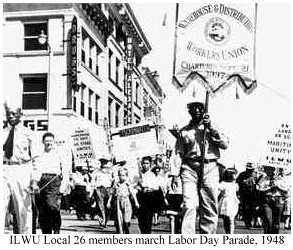
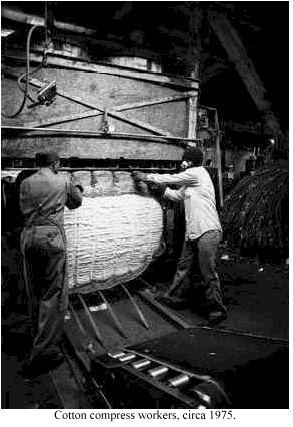
But they persevered, and in the 60 years after their founding would organize a huge range of sites, from cotton compress workers in the 1930s to airport workers in the 1990s.Local 26, for example, built a secure organization, continuously improved wages and successfully combated racial discrimination on the job in the city of Los Angeles, once notorious as the toughest antiunion city on the West Coast. Local 26 jurisdiction over the years grew through aggressive organizing to include scrap yards and cotton compress workers.
 Cotton
compressing, reducing the size of 500-pound cotton bales for shipment and
storage, was brutal work in the 1930s. Bales were hand-trucked to the
"block," which held a huge compressor. Specialized workers like
cotton cutters, or samplers; lever pullers, who activated the press; and
cotton sewers and band shovers, who handled sturdy bale holders, worked
quickly and skillfully.
Cotton
compressing, reducing the size of 500-pound cotton bales for shipment and
storage, was brutal work in the 1930s. Bales were hand-trucked to the
"block," which held a huge compressor. Specialized workers like
cotton cutters, or samplers; lever pullers, who activated the press; and
cotton sewers and band shovers, who handled sturdy bale holders, worked
quickly and skillfully.
Almost all of these workers were African American or Mexican American. Prior to unionization, California's cotton compress workers suffered conditions similar to those of the abused and underpaid migrant workers who worked the nearby cotton fields.
In the wake of the 1934
longshore strike, the ILA set up a cotton compress local at San Pedro in
1936. To protect that local from nonunion operations in th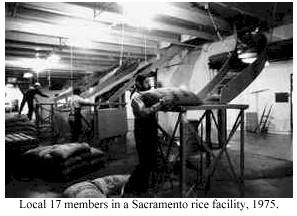 e San Joaquin
Valley, the CIO organized compresses in the Fresno and Bakersfield area in
1937 and '38.
e San Joaquin
Valley, the CIO organized compresses in the Fresno and Bakersfield area in
1937 and '38.
When the CIO purged its most progressive unions for alleged Communist influence in 1949 and '50, the ILWU and the Bakersfield compressmen's international, the Food, Tobacco, Agricultural and Allied Workers (FTA) were among those ousted.
The FTA was devastated, but the ILWU remained strong and aided the isolated Bakersfield unionists. Local 6 briefly serviced them in early 1951, and they were organized later into Local 26 on a permanent basis.
Unionizing the compress industry was never easy. Many of the employers also operated in Southern right-to-work states, and fought hard to reestablish nonunion conditions in California. The ILWU held on, but contract improvements came slowly-compress workers didn't win health and welfare coverage until the 1960s, for example.
Other compress workers in the Valley were represented by the International Chemical Workers Union. In the 1950s the ILWU suggested joint negotiations with the ICWU to reduce wasteful inter-union rivalries and achieve better conditions for all compress workers.
The ICWU compress workers and seed oil pressers were taken with the ILWU's militancy and internal democracy and eventually voted to affiliate with the ILWU as Locals 57 and 78. Local 57 has since merged operations with Local 26, and Local 78 merged with Local 6 in 1994.
This pattern of organized
workers who belong to another union choosing to come into the ILWU has been
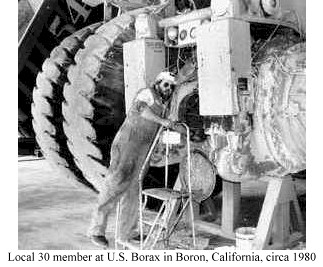
repeated often since the 1950s. In 1964, for example, workers at US Borax in
Boron, California, who had been in Chemical Workers Local 85, voted to
affiliate with the ILWU as Local 30, Mine, Mineral, and Processing Workers.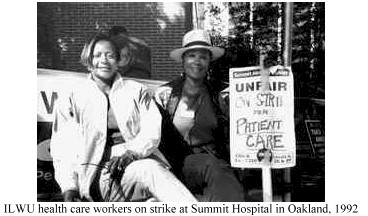
More recently, new ILWU
locals were formed in 1995-1996 from the Los Angeles Harbor Pilots-now Local
68-and the Los Angeles Port Police, now affiliated with the ILWU as Local
65.
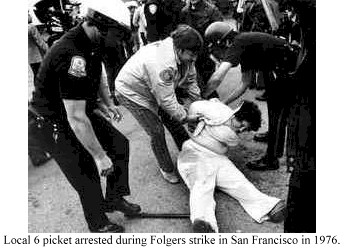
At the same time, the unending efforts of warehouse division employers to downsize, relocate, or completely close down profitable warehouses and manufacturing facilities has wreaked havoc and hardship among the membership.Gone are the employers' traditional complaints of not making money. Now their complaint is that they are not making enough money.
The continuing tide of corporate mergers and acquisitions creates ever larger mountains of corporate debt that must be repaid by maximizing profits by any means necessary-whatever the human cost.
The ILWU has responded to these developments in several ways first, by mobilizing community campaigns to keep the business open, as happened at Miles Laboratories in Berkeley, California; second - when Closure or relocation can't be stopped - by negotiating the best possible protections, severance payments, and retraining benefits for the displaced workers;
third, by strengthening alliances with other unions for collective bargaining, as at the 1992 Summit Hospital strike in Oakland, California, when the ILWU x-ray and laboratory technicians joined with the nurses and other health care workers to successfully protect the right to honor each other's picket lines; and fourth by stepping up the union's efforts to organize the unorganized.