The ILWU Story
The ILWU Story
In 1933 the economic depression that started in 1929 hit the nation full-force. West Coast longshoremen, who had long suffered their own special kind of depression through chronic job insecurity, now experienced even deeper hardship.
Genuine union organization became a matter of survival. The longshoremen once again applied for and obtained a charter from the ILA - but this time they established their organization as a single unit on a coastwise and industry-wide basis, thus avoiding the mistakes of the past.
 Their
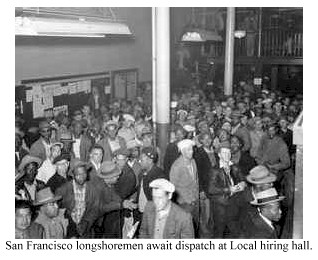
demands were simple: a union-controlled hiring hall that would end all forms
of discrimination and favoritism in hiring and equalize work opportunities;
a coastwise contract, with all workers on the Pacific Coast receiving the
same basic wages and working under the same protected hours and conditions;
and a six-hour work day with a fair hourly wage.
Their
demands were simple: a union-controlled hiring hall that would end all forms
of discrimination and favoritism in hiring and equalize work opportunities;
a coastwise contract, with all workers on the Pacific Coast receiving the
same basic wages and working under the same protected hours and conditions;
and a six-hour work day with a fair hourly wage.
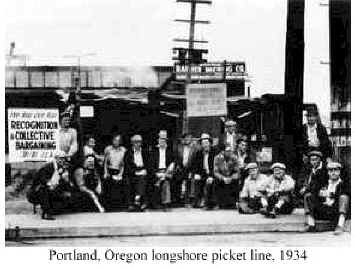
The shipowners consistently refused each demand, determined to divide and destroy the unions in each port. The members of both longshore and seafaring unions voted to strike in May 1934. In response, the employers mobilized private industry, state and local governments, and police agencies to smash the unions and their picket lines.
The ranks held firm throughout the historic strike. They held up against unprovoked police violence, and withstood attempts by the ILA national leaders to cave in to employer demands for a return to business as usual.
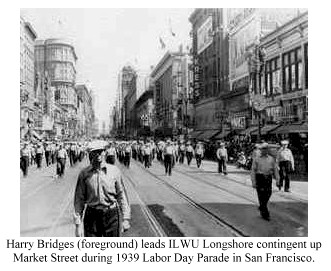
They elected new regional leaders to push the strike forward in defiance of both the employers and the ILA officials. Prominent among the new faces was a San Francisco longshoreman named Harry Bridges, who was later elected president of the ILA's Pacific Coast District and then president of the ILWU.
In July of 1934, when it was clear the longshoremen and their seafaring allies were not going to give up their struggle for justice on the waterfront, the employers decided to open the struck piers using guns, goon squads, tear gas, and the National Guard. They provoked pitched battles in San Francisco, Portland, Seattle, and San Pedro.
Hundreds of strikers - and bystanders - were arrested and injured. On July 5, know ever after as Bloody Thursday, two workers were shot and killed. A total of six workers were shot or beaten to death on the West Coast by police or company goons during the course of the strike.
Rather than breaking the strike, these terrible events galvanized public support, and prompted the unions of San Francisco to declare a brief but historic General Strike to support the longshore and maritime unions and protest strikebreaking by employers and police.
The most conservative leaders of the San Francisco labor movement headed the General Strike, and called it off July 16 after just four days. Still, business and government now knew the maritime strikers had the overwhelming support of the Bay Area's rank and file trade unionists.
 Overseas
support for the strikers also helped impress the employers with the
impossibility of beating the strike with scab longshoremen and scab crews.
And for the first time, most minority workers refused to scab, thanks to the
longshoremen's developing policy against racial discrimination.
Overseas
support for the strikers also helped impress the employers with the
impossibility of beating the strike with scab longshoremen and scab crews.
And for the first time, most minority workers refused to scab, thanks to the
longshoremen's developing policy against racial discrimination.
After the federal government intervened, the union agreed to arbitrate all issues - and won, in principle, each of its major demands.
The union made great organizing gains as the result of the opportunity it gave to the average worker to unite and fight. It sparked the creation of new unions in every industry up and down the Pacific Coast, and the formation of the first multi-employer collective bargaining unit covering an entire industry.
The unity between longshoremen and seafarers also led to the formation of the Maritime Federation of the Pacific, composed of a majority of the waterfront and seagoing unions. Alarmed by the workers' growing solidarity, the shipowners in 1936 sought a test of strength over the unions' gains of 1934.
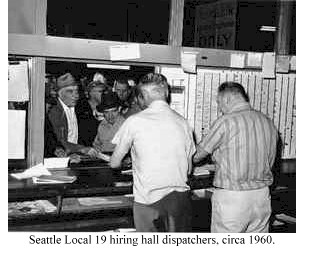
For the first time in the history of any American waterfront the struggle was carried out without a single incident of violence or attempt by the employers to use strikebreakers. The result was a large measure of gains for the seamen, gains which the longshoremen had already won in 1934, including a union-controlled hiring hall. Coast unionism was secure and ready to expand.
The success of the new union came from its solidarity and from its complete democracy. Members stood together and sacrificed together, and they controlled every aspect of the union's life. Self-imposed discipline came from membership participation in every decision, with a shared understanding of every issue.
 The
Pacific Coast District of the ILA, soon to become the ILWU, also led the
campaign for industrial unionism, which would unite all the workers in an
industry in one strong union. Craft unionism, practiced by most unions in
the American Federation of Labor at that time, divided workers in an
industry according to the type of work they did.
The
Pacific Coast District of the ILA, soon to become the ILWU, also led the
campaign for industrial unionism, which would unite all the workers in an
industry in one strong union. Craft unionism, practiced by most unions in
the American Federation of Labor at that time, divided workers in an
industry according to the type of work they did.
The AFL, once an aid to the union's growth, became an obstacle by opposing the new industrial unionism taking hold in its ranks as the Committee for the Industrial Organization, spearheaded by the United Mine Workers' John L. Lewis.
The traditional AFL leadership finally expelled the CIO unions from the Federation. Pressures mounted on the West Coast longshore workers - and their new affiliates in warehousing - to join the CIO.
The organizing successes of the Pacific Coast District thrust the new union into a leadership role in the campaign for industrial unionism.
 The leadership of the Pacific Coast District moved slowly, insisting on full
discussion up and down the coast and, ultimately, on a secret referendum
ballot by the entire membership.
The leadership of the Pacific Coast District moved slowly, insisting on full
discussion up and down the coast and, ultimately, on a secret referendum
ballot by the entire membership.
By the time the vote was taken in late summer, 1937, the AFL and ILA had started assigning the newly organized warehouse workers to other AFL unions, imposed a dues assessment to finance the fight against the CIO, and reaffirmed conservative AFL positions on social programs - including opposition to federal unemployment insurance, old age pensions, and minimum wage laws.
Still the Pacific Coast District tried to resolve their differences without a formal split, and sought an ILA-wide referendum on the issues. But the ILA leadership refused, so the Pacific Coast District held its own referendum. The members voted overwhelmingly to disaffiliate from the ILA - and the ILWU was born.
 Almost
immediately, the ILWU membership vote to affiliate with the new CIO, whose
program of industrial unionism, opposition to discrimination and genuine
nonpartisan political action on behalf of working people exactly matched
their own.
Almost
immediately, the ILWU membership vote to affiliate with the new CIO, whose
program of industrial unionism, opposition to discrimination and genuine
nonpartisan political action on behalf of working people exactly matched
their own.
But the vote for disaffiliation was not unanimous, and three Northwest locals remained with the ILA and the AFL for many years. In Tacoma, Washington, for example, longshoremen did not vote to become ILWU Local 23 until 1958, when shrinking work opportunity motivated them to affiliate so they could travel to nearby ILWU ports for additional work.
Their 20 years of steadfast independence arose from many factors, including strong traditions of regional independence and close cooperation with many area AFL unions.
They had also maintained strong internal discipline over the years, and had prided themselves on attracting and keeping work in the port by emphasizing productivity on the job.
Many union longshoremen therefore felt they could take care of themselves - as they had after the setbacks of 1919 - without deferring to the San Francisco-based leadership of the new union or the CIO. The last Pacific Coast outpost of the ILA, Grainliners' Local 1892 near Longview, Washington, did not vote to join the ILWU's Local 21 until 1981.
 Meanwhile,
the ILWU's brand of rank-and-file unionism spread under the banner of the
CIO, paying off in more gains and greater security for the members of the
ILWU and for all American workers.
Meanwhile,
the ILWU's brand of rank-and-file unionism spread under the banner of the
CIO, paying off in more gains and greater security for the members of the
ILWU and for all American workers.
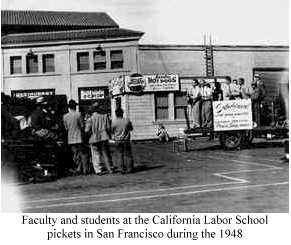
In the decade between 1938 and 1948, the ILWU used its power to help build new CIO unions in processing, manufacturing, service and entertainment industries located far from its waterfront and warehouse bases.
The organizing principles were simple. First, initiate new organization where the local union was willing to participate fully in the campaign. This meant that the local's members and officers took on many of the actual organizing tasks, such as contacting unorganized workers.
The International then mobilized financial and staff resources to support the local's effort. Typical organizing target were non-union businesses that competed with unionized enterprises.
 The
second basic principle of successful ILWU organizing was to consolidate the
union's organization throughout an area, amalgamating small locals into
coordinated larger locals, as happened, for example, in Hawaii, Alaska, and
Northern California.
The
second basic principle of successful ILWU organizing was to consolidate the
union's organization throughout an area, amalgamating small locals into
coordinated larger locals, as happened, for example, in Hawaii, Alaska, and
Northern California.
This proved more efficient administratively, and resulted in greater solidarity among the membership - and greater participation by rank-and-file members in organizing.
But the union's achievements were challenged soon after World War II. Flush with wartime profits, the maritime employers resolved to roll back the economic and social gains won by organized labor.
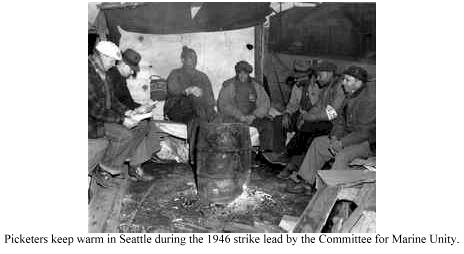
Anticipating an anti-labor labor drive, the ILWU played a leading role in forming the Committee for Maritime Unity (CMU) in 1946.
The successor to the Maritime Federation and the Pacific, the CMU included the ILWU and maritime unions on both coasts. When the CMU opened unprecedented national negotiations in Washington, D.C. on May 30, 1946, a national railroad strike had just been broken.
President Truman had ordered the Army to take over the railroads and the workers were forced to abandon their strike under threat of being drafted into the Army. This new strikebreaking tactic worked so perfectly that Truman decided to use it against the maritime workers. He announced that in the event the CMU struck June 15, as scheduled, the Navy would man the ships and the Army would load them.
The CMU immediately called on its friends and allies in foreign countries to support the American workers in what promised to be a struggle between labor and the armed might of the government. Within hours the telegrams pledging support began to stream in from maritime unions all over the world: New Zealand, Australia, Hawaii, France, England, Poland, Japan, the Scandinavian countries, and others.
In each instance the workers abroad warned that any ships loaded by the Army and manned by the Navy to break the CMU strike would be declared scab ships and tied up the instant they entered foreign ports.
President Truman and his advisors smashed the railroad strike, but they couldn't get the U.S. Army and Navy to handle ships in foreign ports. The admirals, the generals, and the President beat a hasty retreat. The CMU negotiating committee, with ILWU president Harry Bridges as spokesman, achieved a great victory for maritime workers all over the country as wages and benefits were improved, and the union hiring hall was again preserved.
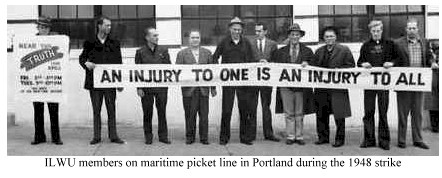
Another test of longshore strength came in 1948 when the heavy players in the Waterfront Employers Association decided the time had come to pressure President Truman to use the new Taft-Hartley law to deprive the ILWU of all of its gains. An anti-labor Congress passed Taft-Hartley, also known as the Labor-Management Relations Act, over President Truman's veto in 1947.
The act outlawed the hiring hall, preferential hiring for union members, secondary boycotts, and strikes over jurisdictional issues, knocking down may of the building blocks for union strength. It also eroded the right to strike by giving the NLRB power to issue injunctions against boycotts and strikes it deemed illegal, and allowing the President to impose an 80 day "cooling-off" period during strikes deemed harmful to the "national interest."
In another inroad on workers' rights and liberties, the Act required elected union leaders to sign affidavits stating they were not Communists before they could hold office (a provision the ILWU later successfully challenged in court).
 Armed with these federal statues, the employers entered contract talks
demanding that the ILWU give up the hiring hall on the grounds that it was
"illegal."
Armed with these federal statues, the employers entered contract talks
demanding that the ILWU give up the hiring hall on the grounds that it was
"illegal."
The union countered with a demand to continue the hall, as well as a series of contract changes, including higher wages, shorter hours, revised vacation rules and improved safety conditions.
The National Labor Relations Board (NLRB) decided to try out another part of the Taft-Hartley law for the first time, and force the workers to vote on the employers' "last offer."
The ILWU's Coast Longshore Caucus recommended that the rank and file boycott the NLRB poll to protest government restrictions on the union's bargaining power.
The result of the vote, as certified by the NLRB after three days of attempted polling, was an unprecedented show of union strength and solidarity: of the 26,965 employees eligible to vote, each and every one heeded the union's call to boycott and not one ballot was cast.
The employers withdrew all their previous offers and announced there was really but one issue in the strike: "Communist leadership." The union refused to be divided by this issue, and the strike began on September 2.
 Then
the break came. Leadership was changed, but not as demanded by the
shipowners. The longshoremen stood by their leaders to a man - the
shipowners changed theirs. They reorganized, called the union back to the
bargaining table and announced, "Gentlemen, there is a new look!"
Then
the break came. Leadership was changed, but not as demanded by the
shipowners. The longshoremen stood by their leaders to a man - the
shipowners changed theirs. They reorganized, called the union back to the
bargaining table and announced, "Gentlemen, there is a new look!"
And there was a "New Look." Gone were the union-busters and red-baiters on the employer side of the table, and after 95 days on the bricks one of the finest trade union agreements ever made was negotiated in the new atmosphere.
The hiring hall continued as it was; wages were increased, union security was reaffirmed and improvement were made in the hours and vacation provisions.
Neither Taft-Hartley nor the NLRB was any more successful than the federal government's threats to use the Army and Navy to break the union.
The next turning point in the history of the Longshore Division came in the late 1950s as the workers confronted technological change on the waterfront - the relentless introduction of machinery by the employers to increase productivity and profits.
After several years of debates in coastwise caucuses, special conferences, and membership meetings, the rank and file ratified the historic - and controversial - Modernization and Mechanization Agreement of 1960 (M&M).
By 1959 the shipping industry was confronting difficult operational problems. Post-war construction costs skyrocketed the investment needed to build and maintain ships. The price of fuel, wharfage fees, and wages for seafaring personnel all moved up with the times.
The only way to offset these rising costs was to speed cargo handling and ship turnaround time. Speedier loading and discharge not only improves the ship's turnaround time, it also increases the number of trips the vessel can make each year. Increased earnings resulting from the introduction of new machinery and new methods of cargo handling could well enable the industry to remain profitable.
Meanwhile, the union concluded that new methods and machines would be introduced no matter how great members' resistance to change. As employers had the contractual right to make changes in operations, the best the union could hope for was to retain the old rules governing size of gangs, methods of cargo handling and related contract guarantees, as long as possible.
New ideas for cargo handling, revolutionary ship design, the introduction of strapped loads, large-scale use of containers, and numerous other devices would sooner or later bypass the existing rules. Proposed legislation would also outlaw may of the guarantees and safeguards afforded by the old contract, leaving the workers with no new forms of security or protection in exchange.
Clearly the time had come to reexamine labor relations in the light of the mechanization and modernization of West Coast longshoring. The union and the employers decided they were better off tackling the issues as a whole, and agreed the following principles would shape the 1960 contract: the shipowners and stevedoring contractors were freed from restrictions on the introduction of labor-saving devices, relieved of the use of unnecessary workers, and assured of the elimination of work practices which impeded the efficient flow of cargo.
The union made these guarantees to industry in exchange for an unprecedented series of benefits for the workers, designed to protect them against the negative impact of machines on their daily work and job security. The agreement provided that:
The current workforce would not be laid off. If the unhindered introduction of new machinery and methods of work resulted in the loss of work opportunity so that the work force had to be reduced, it would shrink from the top, with an innovative voluntary early retirement program instead of layoffs. If employers later needed to cut the workforce further, they could invoke a compulsory retirement provision with a higher pension benefit.
Increased profits would be shared with the workers in the form of increased wages and benefits. Machines and labor-saving devices would be introduced wherever possible to lighten the burden of hard and hazardous work.
During longshore bargaining in 1966, the principle of M&M were extended under union pressure to "preserve the present registered force of longshoremen as the basic work force in the industry, and to share with that work force a portion of the net labor cost savings to be effected by the introduction of mechanical innovations, removal of contractual restrictions, or any other means."
Significantly, these innovations were to implemented without causing a speedup for the individual worker, indiscriminate layoffs, or a violation of safety codes or rules.
 Problems arose, of course, in the implementation and interpretation of the
two five-year contracts negotiated to bring the new program to life in a
period of stable labor relations.
Problems arose, of course, in the implementation and interpretation of the
two five-year contracts negotiated to bring the new program to life in a
period of stable labor relations.
Rank and file support for M&M had never been unanimous, and growing concerns about threats to ILWU jurisdiction, to the equalization of earnings, and to work opportunity gave rise to a new militancy among the younger generation of longshore workers in 1971.
Contract negotiations in 1971 centered on the consequences of containerization. When talks reached an impasse over union jurisdiction, wage parity and work rules, the resulting strike vote was a resounding 96.4 percent "yes" - a measure of the solidarity that sustained the longest coastwise longshore strike in US history.
For many members, especially in San Francisco's Local 10, the central issue was whether or not the employers would be able to redefine work rules and job categories to create a new class of workers for container operations, 'steady men' who would report to the same company every day instead of going to the hiring hall for jobs.
After 134 days on strike, the members accepted a new agreement by a 71 percent "yes" vote. The settlement contained some improved language on container jurisdiction, new dental benefits, the first five paid no-work holidays, and a new "Pay Guarantee Plan" that made significant steps towards establishing a guaranteed annual income for registered longshoremen whose work opportunity declined due to mechanization and other economic factors.
But the settlement terms were not far different from the employers' last proposal before the strike started. And it began the long process that transformed longshore work along the entire coast, especially in Southern California, by the spread of "steady" equipment operators who rarely went to the union hall for their job assignments.
 The
1971 strike also brought the ILWU face to face with the combined effect of
technological innovations and the integration of international economies.
Containerization enabled employers to avoid struck ports by offloading US
cargo through Canadian and Mexican ports and trucking it into the country.
The
1971 strike also brought the ILWU face to face with the combined effect of
technological innovations and the integration of international economies.
Containerization enabled employers to avoid struck ports by offloading US
cargo through Canadian and Mexican ports and trucking it into the country.
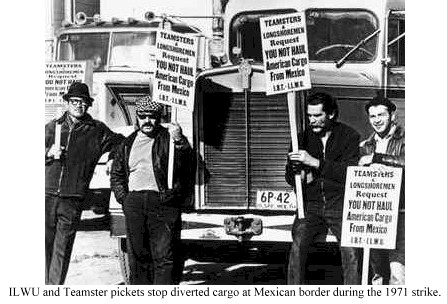
Increased solidarity among the workers somewhat offset this advantage. ILWU and Teamster members halted movement of diverted cargo to and from the Mexican port of Ensenada by US drivers.
(both unions recognized the enormous legal and financial pressures placed on Mexican nationals by their own government and employers to drive diverted cargo across the border, and did not blockade those vehicles)
To the north, the ILWU Canadian Area voted not to handle diverted US cargo, despite threats of heavy fines and imprisonment. They soon called off this boycott, however, to avoid a potentially fatal showdown with the Canadian government after British Columbia court rulings against the union.
Ultimately the Canadian ILWU escaped penalties, because the court ruled the union boycott was enacted in good faith to prevent union members from being forced to work as strikebreakers - and because the longshore workers in Vancouver had handled Canadian cargo as needed.
Since the 1971 strike, the Longshore Division has steadily defended and organized its jurisdiction. Employers provoked several skirmishes over new longshore operations, usually by attempting to whittle away at existing ILWU jurisdiction. The union has also had to protect its jurisdiction in the face of constant technological change in the computerized era of intermodal transportation.
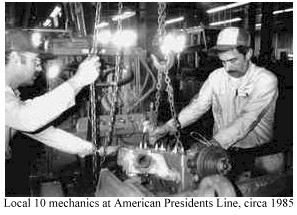
The ILWU responded to these threats with organizing campaigns to bring all unorganized waterfront workers into the union, including office clerical workers employed by shipping and stevedoring companies, workers at new intermodal rail yards, and mechanics engaged in the maintenance and repair of containers and related cargo-handling equipment.
In the 1970s, for example, newly organized office workers at Zim-American Israeli Shipping and Matson Navigation joined clerical units in either Ship Clerks Local 63 in Southern California, or Local 34 in the San Francisco Bay Area, and yard workers at Southern Pacific's Intermodal Containers Transfer Facility (ICTF) voted in 1987 to join the new Allied Division of Southern California's Longshore Local 13.
 And in 1995, a major organizing drive among vessel planners - who determine
the load, weight, and balance of a ship's cargo - was initiated in Southern
California by Local 63's office clericals and marine clerks units, with
longshore support from Local 13.
And in 1995, a major organizing drive among vessel planners - who determine
the load, weight, and balance of a ship's cargo - was initiated in Southern
California by Local 63's office clericals and marine clerks units, with
longshore support from Local 13.
By the end of the 1996, the successful drive - strengthened by new jurisdictional language in the 1996 longshore contract settlement - expanded northward to planners in Northern California, Tacoma, and Seattle.
These organizing successes did not come easily, and many employers have not only resisted unionization, but have also sought to bypass or curtail traditional ILWU jurisdiction on the waterfront.
When this has happened, the entire Longshore Division,
along with the Warehouse Division, mobilized to defend its jurisdiction and
right to organize. The number of these struggles increased in the late
1980s, as waterfront employers appeared emboldened by the anti-labor climate
in the nation's capital.
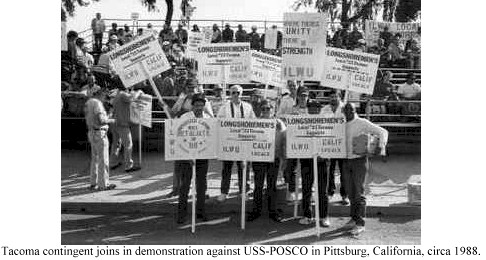
More than 12,000 trade unionist joined the demonstration. For the next four years the ILWU worked closely with organized labor and environmental groups to hold USS-POSCO (a joint venture between US Steel Corporation and POSCO, a Korean conglomerate) accountable for its anti-union policies and the threat its Pittsburg facility posed to environmental safety in the region.
In 1992 the ILWU signed an agreement with USS-POSCO ending the dispute. The pact fell short of total victory, but it did protect the ILWU's jurisdiction should the facility be used by other companies, and provided for significant fines should USS-POSCO pollute the environment. Perhaps just as important, the four-year campaign brought the environmental and labor movements closer together.
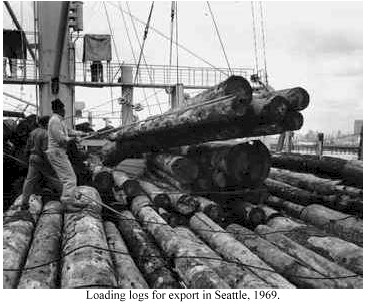
 Between
1987 and 1989 ILWU members in the Northwest defended longshore jurisdiction
against attempts by the giant ITT-Rayonnier corporation to use nonunion
operations to barge and ship logs for export.
Between
1987 and 1989 ILWU members in the Northwest defended longshore jurisdiction
against attempts by the giant ITT-Rayonnier corporation to use nonunion
operations to barge and ship logs for export.
Union members eventually shut down all Washington and Oregon ports to participate in a 1989 meeting and demonstration against Rayonnier - and assured future operations would be handled by ILWU labor.
In 1989 the ILWU was also able to win an important fight against foreign seamen doing ILWU longshore work when the union's attorneys successfully intervened against Canadian shipowners who tried to use crew members to operate cranes in log loading operations while in Northwest US ports.
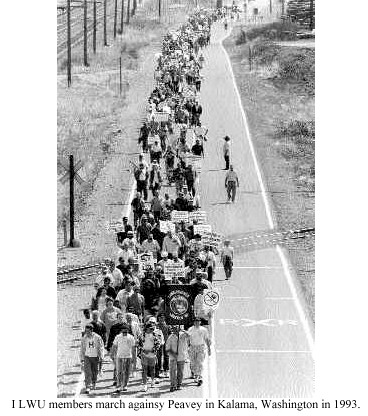
In 1993 the entire ILWU was forced to fight a major battle with Peavey, a ConAgra subsidiary, when Locals 21 and 40 tackled the grain giant at its grain elevator in Kalama, Washington. The ILWU gained community support - and government attention - when it exposed Peavey's illegal practice of soaking grain, which increased its weight and thereby brought a higher price for the cargo.
The union also mobilized international support, most successfully in Japan, against the company's proposed cuts in manning levels and plans to impose other substandard conditions.
The company was forced to compromise on its contract proposals, and also ended up paying a major fine in 1997 for its grain-soaking practices. While there have also been setbacks, times when the combined power of the rank and file could not prevail against the employer - most notable in the bitter and sometimes bloody fight from 1992-1995 to maintain ILWU jurisdiction at Southern Pacific's Intermodal Container Transfer Facility in Southern California, -- the union became even more determined to protect its jurisdiction.
This determination backed up by coastwise unity, was in large part responsible for the major gains achieved in the 1996 Pacific Coast Longshore contract. Not only did the contract clarify and nail down ILWU jurisdiction over on-dock intermodal rail yards, it also forced employer acceptance of ILWU jurisdiction over intra-port drayage of containers, container maintenance and repair operations, and vessel planning.
Just as important, the longshore membership took on and eliminated the employers' "side deals" with individual skilled equipment and crane operators - the divisive practice whereby an employer paid bonuses to some workers to work steady for that employer.