The ILWU Story
The ILWU Story
ILWU policies and actions on foreign affairs have always been built on the belief that international labor solidarity and world peace are the cornerstones of social and economic justice for all workers, including the membership of the ILWU.
Today, when new chemical and thermonuclear weapons and stealth technologies are capable of destroying people, cities, animals, plants and even poisoning the atmosphere itself for centuries, the ILWU is unanimous in concluding that only in a stable, secure, peaceful world can this, or any other union, hope to be able to fight for and win those improvements in the lives of the members to which the trade union movement is dedicated.
 The
union's commitment to a peaceful world has been expressed in many ways, each
following a course of action or basic policy set by the membership through
the International Convention.
The
union's commitment to a peaceful world has been expressed in many ways, each
following a course of action or basic policy set by the membership through
the International Convention.
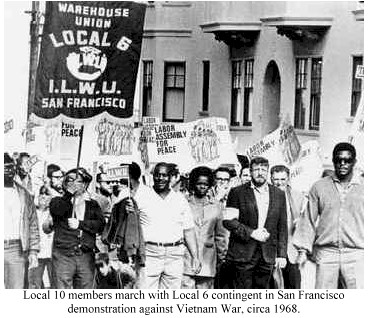
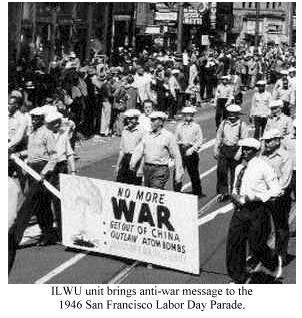
In the 1930s the ILWU blocked the shipment of supplies to the rising fascist movements in Europe and Asia. After World War II the union opposed escalation of the arms race and the Cold War. In the early 1960s the ILWU was the first union to stand up in opposition to US military intervention in Vietnam in 1964.
Over the next decade, the union joined with a host of regional and national anti-war coalitions and demonstrations-and, led by Lou Goldblatt, helped organize Labor for Peace.
The union's policy called for an end to the bombing of civilian populations, the withdrawal of US military forces, and a negotiated settlement of the civil war.
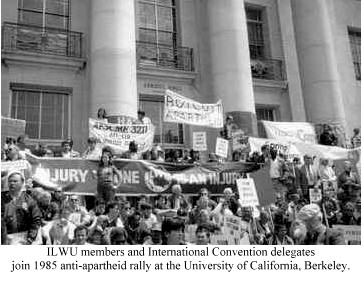
The ILWU was also the first union to oppose the imposition of apartheid in South Africa-the brutal system of racial segregation legislated by the white minority government in 1948.
In the 1980s ILWU longshore members, most notably in Local 10, repeatedly refused to handle South African cargo. On other levels, union officers used their economic leverage as pension fund trustees to successfully back shareholder moves to end investment in South African businesses.
By the 1970s, as world attention was focused on events in Latin America, the ILWU took a firm stand against military dictatorships in Chile and El Salvador. In 1974 the ILWU joined an international boycott of Chilean cargo following the overthrow and murder of democratically elected President Salvador Allende by a CIA-backed military junta.
Then, in 1978, Local 10's refusal to handle bomb parts bound for Chile called national attention to attempts by the US to hide its own military sales to Chile.
 A similar boycott was imposed by the ILWU in 1981 on military cargo bound for
the dictatorship in El Salvador, Then, in 1989, the union became a key
player in a national boycott of Salvadoran coffee organized by
Neighbor-to-Neighbor to protest torture and other human rights abuses in El
Salvador, including the bombing of union headquarters there.
A similar boycott was imposed by the ILWU in 1981 on military cargo bound for
the dictatorship in El Salvador, Then, in 1989, the union became a key
player in a national boycott of Salvadoran coffee organized by
Neighbor-to-Neighbor to protest torture and other human rights abuses in El
Salvador, including the bombing of union headquarters there.
The boycott was aimed it bringing pressure on the Salvadoran government for peace negotiations. In addition to the longshore actions, ILWU warehouse locals pressured coffee-roasting companies - many of whom were ILWU employers-to eliminate purchases of Salvadoran coffee.
The ILWU has been guided in these actions by the conviction that solidarity with workers of all lands is sound union policy. To help build this understanding, the ILWU has sponsored overseas delegations of rank-and-file members and has, in turn, hosted trade union visitors from every continent.
The ILWU has also routinely shared information about collective bargaining and working conditions with foreign unions and labor federations.
After World War II, for example, ILWU representatives went to the Philippines, Mexico, Puerto Rico and Cuba to plan joint action and share knowledge and information on how best to advance the interests of sugar workers. Similarly, sugar union representatives from these areas came to San Francisco to meet and coordinate activities with the ILWU. Late in 1947 the ILWU participated in the formation of an International Sugar Workers Committee.
Meeting in Havana, Cuba, the Committee elected Louis Goldblatt chairman and adopted a program of action designed to end the exploitation of the workers by the international sugar cartel. Represented, in addition to ILWU, were the Cuban National Federation of Sugar Workers, the Sugar Workers Union of Puerto Rico, and the Mexican Sugar Workers Union.
Long ago the union came to the conclusion that if it was to know and understand the labor movement on a global scale it would have to obtain this information first hand. In 1948 the ILWU sent four rank-and-file members to Europe on a fraternal visit. It was the first such delegation sent by the union and the first strictly rank-and-file overseas delegation on record from any American labor union.
In 1959 the union took another step never before contemplated by any American union: the 13th ILWU Biennial Convention recommended, and the membership later ratified in a secret referendum vote, an assessment of $1 per member to send rank-and-file delegations to visit trade union members and leaders in other countries.
Officers and staff members of the international union were not barred from participating if the union thought it necessary to send some of them with the delegations, but the measure adopted made it clear that in such cases their pay and expenses would not come from the special fund built by the rank-and-file assessment.
The overseas delegates were nominated by the locals. From the nominees the International Executive Board selected participants on the basis of regional representation. More than 200 members have participated in the terms of rank-and-file delegates that visited more than 40 countries on six continents, including several socialist countries, since 1960. Their detailed reports were regularly published in the ILWU's newspaper, The Dispatcher.
In 1977 the ILWU Convention voted to cap the fund and send the delegations only as events and conditions warranted, since many countries had been visited several times. Then, in 1985, the Convention agreed with an Executive Board recommendation to temporarily suspend the overseas program (and diversion of dues to fund it) as part of a larger package of cost-cutting measures - and because volatile world conditions made it too difficult to guarantee the delegates' safety.
 Although the 1988 ILWU Convention extended the suspension of the overseas program,
and the 1991 Convention eliminated it, the Longshore Division - after voting
at a 1987 caucus to empower locals to send and receive overseas delegations
- has continued to encourage the exchange of worker delegations with other
waterfront unions.
Although the 1988 ILWU Convention extended the suspension of the overseas program,
and the 1991 Convention eliminated it, the Longshore Division - after voting
at a 1987 caucus to empower locals to send and receive overseas delegations
- has continued to encourage the exchange of worker delegations with other
waterfront unions.
In 1993, for example, the Division sponsored delegations to Southeast Asia, and special delegations have continued to travel the globe on fact-finding missions, to show solidarity with foreign workers, and to represent the interests of the ILWU in international conferences and federations.
Special delegations have sometimes been dispatched by the International Union, as in 1990 when the International President and Vice President attended the Extraordinary Congress of the USSR Sea and River Workers Union called to deal with conditions of work and the reorganization of their union which, while emerging from 70 years of bureaucratic leadership, wanted to learn about the ILWU's experience in building a democratic industrial union of many occupational jurisdictions.
More recently, the ILWU sponsored several trips to Mexico between 1992-1996 as solidarity with Mexican workers became more critical with the rapid privatization of that nation's ports, new repression against their unions, and implementation of the North American Free Trade Agreement (NAFTA).
At first glance the way for labor to avoid potential catastrophe caused by free trade agreements seemed simple: call a halt to all international trade agreements and protect workers from dislocation and exploitation.
But the ILWU has always viewed the issue as infinitely more complex than that. As the union told the US Senate Finance Committee in 1970, "We oppose protectionism which we fear will feed inflation and provoke retaliation to the point where millions of Americans will be affected."
Because the ILWU's membership includes longshore workers who rely on international commerce for employment, sugar workers in Hawaii who need legislative protection from sugar imports, warehouse workers who handle both domestic and international products, and hotel workers whose livelihood rests on a growing global economy, the union has sought to develop a solution to the trade problem that answers all members' concerns.
The union's efforts have gone to support fair trade and to support workers and their unions in Mexico and elsewhere in their struggle for basic trade union rights: freedom of association, free collective bargaining, and fair representation.
This is also why the union has opposed trade sanctions against the socialist countries of Cuba and China - policies which punish workers and their families, and ultimately aggravate international tension to the point that peace itself is threatened.
The ILWU's commitment to peace and solidarity has also meant that the union has been deeply involved in the fight to protect and expand labor rights, particularly in countries threatened by the globalization of the world economy and privatization of major industries, including ports and other transportation facilities.
On an organizational level, the ILWU has devoted considerable time and energy to building international unity among transport unions through the Congress of Industrial Organizations (CIO), the Maritime Federation of the Pacific, the Maritime Federation of the World, the Committee for Maritime Unity, the World Federation of Trade Unions (WFTU), the International Labor Organization (ILO), and the International Transport Workers Federation (ITF).
Under the leadership of Bridges and Louis Goldblatt, the ILWU early on also recognized that the Union's welfare was closely tied to the labor movements of Asia, Australia, and the Pacific region. Trade union solidarity throughout this area was important to the ILWU in North America, and to IWLU members in Hawaii.
After years of effort, the ILWU in 1959 helped initiate the first All Pacific and Asian Dockworkers Conference (with Australia, New Zealand, Japan, and the Soviet Union). These alliances soon produced concrete results when ILWU longshoremen in Hawaii and along the Pacific Coast, including Alaska and British Columbia, stopped work on 10 Japanese ships for 24 hours in solidarity with striking Japanese longshoremen in 1960.
In 1980 the Union affiliated with the Pacific Dockworkers Consultation and Correspondence Committee. That same year Hawaii's Local 142 sponsored the first in a series of international conferences on the dangers of nuclear power and radioactive materials for the peoples of the Pacific, and particularly for transport workers. In a similar vein, the ILWU has shared scientific information with Japanese longshore unions on hazardous pesticides present in cargo-handling.
In 1993 the Waterside Workers Federation of Australia, Zenkowan of Japan, and the ILWU hosted a Pacific Rim Dockers Conference in San Francisco, called to expand on a 1992 ITF Yokohama Dockers Conference. Participants in the Pacific Rim Conference issue a joint communiqué noting common employers and shared problems required improved union communications, coordination of research, opposition to privatization, exchange of delegations, and mutual aid.
The Longshore Caucus approved affiliation of the Longshore Division with the ITF in 1986. The decision was made after lengthy discussion. Several delegates were concerned that the ITF, which historically was primarily a federation of seafarers and truckers, did not have sufficient representation from the shoreside work force to warrant ILWU affiliation.
These concerns were soon outweighed by recognition of the larger need to strengthen organizational ties among all transport workers, by encouragement from longtime friends of the ILWU in foreign waterfront unions, and by the understanding that the Union's own Marine Division might benefit from closer ties to the ITF.
Affiliation of the Division was finalized in 1988. Additional benefits of affiliation became clear within a few years as the ILWU sought-and received-international support for curtailing the performance of longshore work-by seafarers when foreign ships were in US ports. Then, beginning in 1992, the ITF agreed to have the ILWU play a direct role in administering the Inspectorate on the Pacific Coast.
Under this system, the ITF funds individual inspectors in major ports who monitor the conditions under which seafarers work aboard foreign flag vessels - and how they are paid. The inspectors also attempt to bring nonunion crews under the ITF's collective bargaining agreement for international crews. This new arrangement not only increased services and protections to foreign seafarers - in many instances ILWU longshore locals took direct action in support of these workers when they were abused, sick or exploited-it also provided the ILWU with a new avenue to communicate with foreign workers in the maritime trades, and to shore up mutual assistance when necessary
The strength of the ILWU's international connections has always rested on the union's willingness to back up the just demands of workers everywhere, regardless of affiliation.
This principle underlay the ILWU's leading role in support of striking dockers in Liverpool, England, in the 1990s, as they fought back against the union-busting privatization of British ports - and led the ILWU Longshore Division to call a one day work stoppage at the major West Coast ports as part of an international day of solidarity with the Liverpool workers on January 20, 1997.
The ILWU's action was the largest and most effective taken that day, and effectively served notice on shipowners and waterfront employers, in the US and overseas, that worker solidarity is very much alive.