The ILWU Story
The ILWU Story
Canada
A bitter and protracted struggle was fought to establish the ILWU in British Columbia, Canada's westernmost province. In 1912 the International Longshoremen’s Association began organizing in Canada, and the Lumber Handlers’ Union became part of the ILA in Vancouver. Wage struggles marked the early years of ILA locals in Canada, and the union was able to win some fair rates of pay.
In 1923, however, the employers' Shipping Federation provoked a major Vancouver longshore strike with the hope of smashing the ILA. Imported strikebreakers loaded ships with the help of office workers, and employers imported hundreds of men armed with shotguns. The strike was finally lost after almost two months.
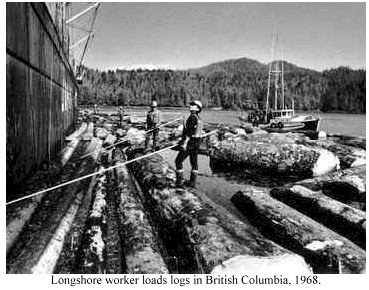 For the next 12 years, very little union organizing took place in British
Columbia ports and with the onset of the Depression conditions worsened.
For the next 12 years, very little union organizing took place in British
Columbia ports and with the onset of the Depression conditions worsened.
But by 1934 longshoremen, seamen and other maritime workers established a new organization: The Longshoremen and Water Transport Workers of Canada.
By the spring of 1935, longshoremen in virtually all ports in British Columbia were organized and the employers provoked another major strike, locking out 50 longshoremen at Powell River when they demanded higher wages and better working conditions.
Longshoremen in Victoria then refused to unload the ship whose paper cargo had been loaded at Powell River by non-union mill hands.
On June 4, some 900 longshoremen were locked out by the Shipping Federation after gangs refused to load paper from Powell River aboard another ship, and office workers at Canadian Pacific were ordered to work ships' cargoes.
Seattle longshoremen also refused to unload cargo from Vancouver. On June 18, 1935, Vancouver longshoremen marched to Ballantyne Pier to protest employer actions.
They were met by massed police firing tear gas, and mounted police riding their horses through the workers' ranks, swinging their clubs indiscriminately in what a Vancouver newspaper described as "the bloodiest hours in waterfront history." Police smashed the windows of the longshoremen's hall and hurled tear gas bombs inside, where women's auxiliary members had established a first aid post.
 Vancouver's
mayor charged that "Communist agitators" incited the riot, and
insisted the port remain open. By the beginning of July, Pacific Coast ILA
locals voted to declare British Columbia cargoes unfair and refused to act
as strikebreakers by touching the "hot cargo.
Vancouver's
mayor charged that "Communist agitators" incited the riot, and
insisted the port remain open. By the beginning of July, Pacific Coast ILA
locals voted to declare British Columbia cargoes unfair and refused to act
as strikebreakers by touching the "hot cargo.
"A Canadian government-sponsored inquiry into the dispute ruled that the strike was not in the interests of sound labor organization, because it was merely a "sympathy strike."
The courts, meanwhile, were handing out harsh sentences to strikers and sympathizers, including imprisonment and lashing. Important leaders were arrested and imprisoned and by December the strike was lost.
A small group in New Westminster, that somehow managed to maintain Local 38-127 of the ILA after the defeat of the disastrous 1935 strike, made the first attempt to bring the ILWU to British Columbia in 1937.
Dissatisfied with the lack of service by the ILA, Local 38-127's members applied to the ILWU and were issued a charter, becoming ILWU Local 1-58. By the time of the first ILWU International Convention in 1938, convention delegates noted that more thin half of the 1,900 Canadian longshoremen on the coast were kept out of work by the employer blacklist established after the 1935 strike.
This economic hardship led to the rapid decline of the two remaining locals, and the 1939 International Convention recommended that their charters be lifted. But at the Third International Convention in 1940, the ILWU resolved to again organize in British Columbia, and the 1941 Convention set up District 5 Canada.
 While
these attempts to establish ILWU locals were going on, workers were also
making efforts to transform the company unions formed in 1935 into genuine
unions. By 1943, six of these company-dominated unions joined together in
the B.C. Council of Longshoremen.
While
these attempts to establish ILWU locals were going on, workers were also
making efforts to transform the company unions formed in 1935 into genuine
unions. By 1943, six of these company-dominated unions joined together in
the B.C. Council of Longshoremen.
Despite employer domination of these groups, sentiment grew rapidly in favor of more militant action and for unity of all longshoremen on the West Coast. Disillusioned with their own organization and the ILA, a movement developed to join the ILWU.
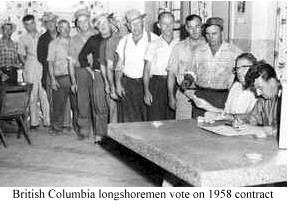
However, it was not until 1944, when a general upsurge of trade unionism took place on the Canadian coast, that the ILWU was established in British Columbia - this time to stay - when the independent Vancouver Waterfront Workers Association voted unanimously on March 1, 1944 to join the ILWU.
Within the space of a year, two more longshore locals were chartered. By the end of 1945, these new ILWU affiliates formed a council of British Columbia ILWU locals, which adopted proposals to embark upon economic, educational and political action programs, and to deal with such pressing needs as a potential master longshore contract, unemployment insurance, penalty pay rates, and hours of work.
 By
By
The all-Canadian ILWU convention was an important step toward strengthening the autonomy of the entire Canadian labor movement. Subsequent conventions reflected the political, social, and economic aims of the ILWU in Canada.
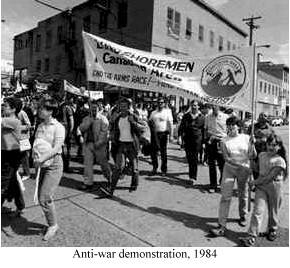
They called for an end to arms spending and the replacement of war preparation with vast new public works programs. They also supported the Canadian government's stand in promoting trade with Cuba while keeping British Columbia ports busy with grain shipments to mainland China.
The adoption of a Constitution for the Canadian Area granting autonomy to the Canadian membership within the International Union was the highlight of the 1959 founding convention.
And in 1973, the ILWU International Convention approved giving the Canadian Area sole authority for granting charters, and for the receipt and administration of all Area per capita dues payments. The ILWU was the first, and remains one of the few, International Unions to provide such complete autonomy for its Canadian membership.
 In
the years after autonomy, Canadian longshore locals negotiated contracts
that gradually won increased wages, better conditions, a coastwise contract,
and other improvements.
In
the years after autonomy, Canadian longshore locals negotiated contracts
that gradually won increased wages, better conditions, a coastwise contract,
and other improvements.
But each step was marked by bitter struggle. In 1966 leaders were imprisoned for refusing to order men to work on a Canadian federal holiday (Queen Victoria Day).
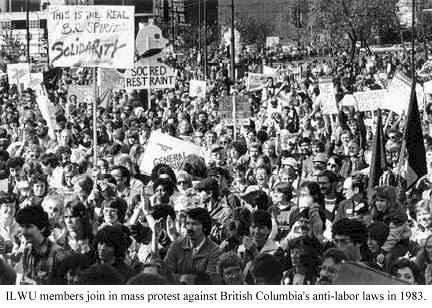
Respect for their action led to government approval for covering longshore workers under the Canadian labor code. Over the past 20 years the ILWU Canadian Area has been an important part of every effort to unify organized labor in British Columbia against restrictive provincial labor laws.
The Area participated in brief work stoppages and a one-day general strike to protest labor code revisions gutting legal protections for bargaining, the right to strike, boycotts, and picketing. Deral edicts have repeatedly and arbitrarily forced striking longshore workers back to work.
Area leaders have often endured imprisonment and severe fines for their actions. At the same, the Area's reputation for responsible and effective leadership, progressive policies, and internal democracy has attracted thousands of new members formerly affiliated with other unions in the transport and distribution industries of Western Canada. Since 1990, the Canadian Area has been the fastest growing sector of the ILWU, and now represents workers in other parts of Canada.